
In Conversation: Wilco’s Mikael Jorgensen
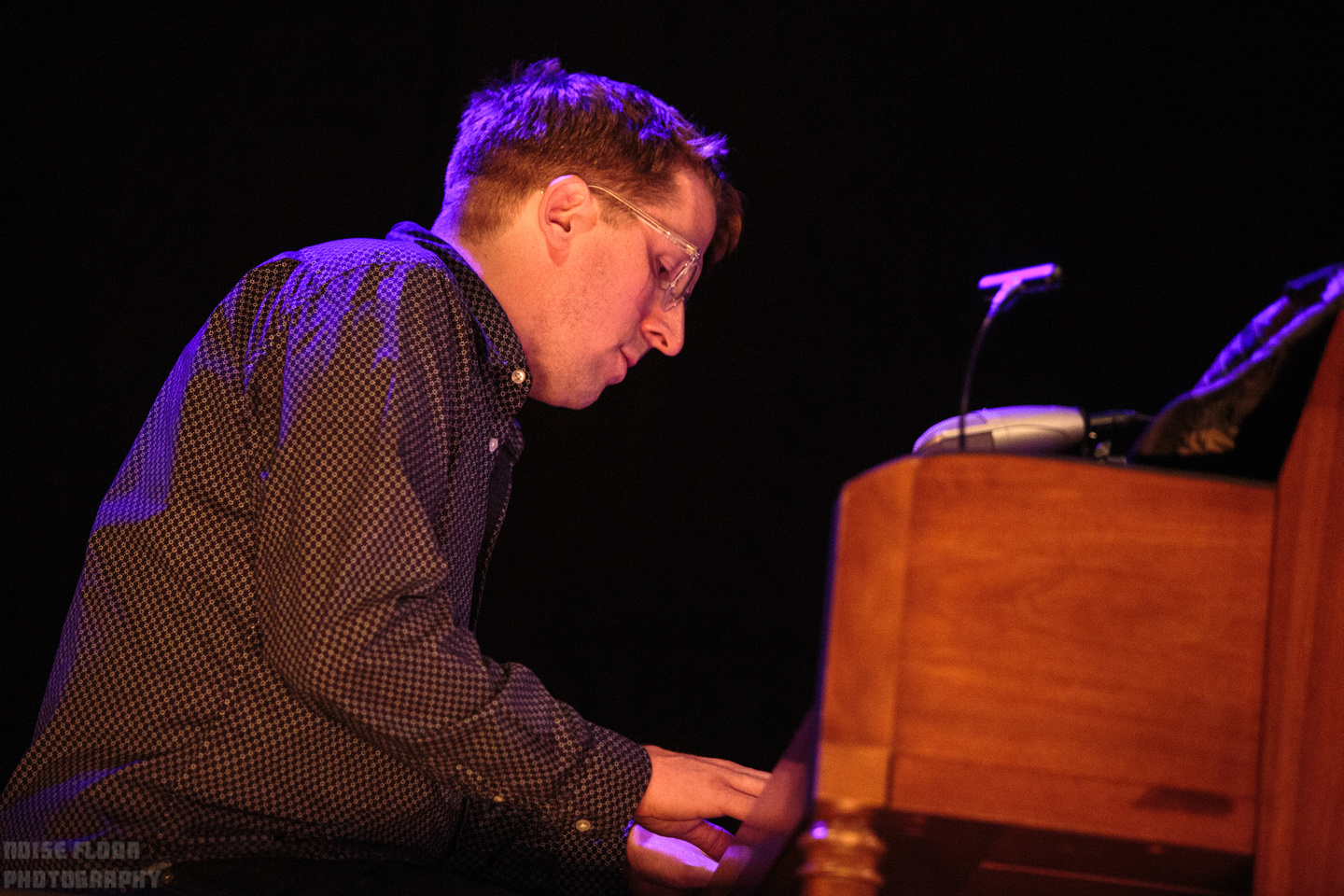
Noise Floor contributor Nick Calvino chats with the multi-instrumentalist about life and art in quarantine.
Editor’s note: Nick and I had the pleasure of working together during our college days at Northeastern’s Tastemakers Magazine, though he was a remote contributor and thusly, neither of us actually knew one another at the time. I’m excited to welcome him to Noise Floor with a lovely and lengthy conversation with a member of one of our mutual favorite bands. This interview was originally conducted in late May. To respect coverage of the protests that soon followed, Noise Floor and Mikael Jorgensen decided to hold off publication for a few weeks.
Like so many, Mikael Jorgensen is adjusting.
Touring is at a standstill with no end in sight. Parents have been thrust into the role of part-time educators. But he is finding pockets of time to exercise his creativity as a means to process. In the past month, he has posted several new tracks and plenty of archived material to his Bandcamp, all while juggling several collaborations from a distance.
We spoke to Mikael from his home in Ojai, CA to discuss these latest works, looking back at past work, new records on the horizon, goings-on in the world of Wilco, the inspirational positivity of Can, and much more.
NC: You can’t really get away from the current situation with the pandemic. There was an episode you did of the Workin’ It podcast where you laid out your typical daily schedule when on tour. I was wondering if you could give an idea of what a typical day for you now might be – especially when looking for time to fit in creative projects with everything going on.
MJ: It’s certainly a different set of concerns than being on the road [laughs]. It really comes down to learning how to homeschool our kids. My wife and I sort of tagteam different parts of that in the mornings. And then in the afternoons, my wife [artist Cassandra C. Jones] will go to her studio and work for a few hours until dinnertime. My creative juices flow the most freely at night, so I’ll usually go to the studio anywhere from 8 or 9 p.m. until…as late as I can responsibly stay awake.
That’s kind of the rhythm and pace that has happened over the course of the last 73 days. I’ve found that there’s no shortage of awful news happening in the world. Whether it’s learning about people who have died because of this disease or the practically irresponsible handling of this epidemic by our administration…to all the other things that are happening that are really kind of ripping our society apart in this way that’s troubling and deeply, profoundly saddening.
But as far as our community here goes, I live in Ojai, CA where the running joke is that “Ojai is 30 square miles surrounded by reality” [laughs]. And as far as official cases of the virus here, there have only been six, the last time I checked. So it’s pretty unlikely that there’s any virus here, but we get a lot of visitors from L.A. and from around the state – certainly on the weekends. So I don’t think we’re necessarily “immune” to it, but there isn’t that constant, everyday dread or stress of “do I have it?”
That said, there’s all of that to think about. But when I go to my studio, I can find some musical outlet that really provides me with a reprieve from all of that hideous news going on. And I can just lose myself in the moment. The practice is pretty varied, too.
N.C. I think that some people might have a perception of this all being a good time for creative types in offering “downtime” for their artistic pursuits. But I imagine, like with any profession, you can’t ignore society at large and the stresses wearing on you. It must be a really strange time to come to anything concrete when you’re also dealing with all of this.
M.J. I certainly am not representative of the “creative class” [laughs]. I mean, my wife is an artist and her mode of expression through all of this has wound up being writing. She has been keeping a very detailed and thorough journal this whole time. But I’ve really just found even more solace…or maybe not even solace…maybe “escape”…in the process of making something new. It just feels hopeful and, looking towards the future, that we’ll still be able to support the arts in some way.
My wife and I have talked about that there’s been a silver lining to this experience that we really didn’t expect – that our family has bonded and grown closer during this. Because of the virus, and as a result of, if that distinction makes any sense.
NC: Yeah. I think it might give people the space to gain perspective of what is truly important that’s in front of you. That, in any other situation, you might be running around and dealing with any number of obligations.
MJ: I think that our principle responsibility, besides making sure that we still have some kind of income, is keeping our children educated. And I’m almost 50. So my grade school experience did not involve computers in any way. So to see my 9-year-old do his schoolwork on the computer is like “Oh, this is how it is now.” It took me a minute to get square with it.
But our school system here has done a really great job of transforming their curriculum to this distance-based learning model. And it’s probably not perfect, but it’s the best that we’ve got so far. But that takes up a good part of the mornings and our day. And then we try to go for bike rides to get some exercise and I go to the studio in the evening. And that’s been the routine.

NC: The last three or so releases that you put up on Bandcamp vary greatly in genre. Are these very specific exercises in style, or are you just finding yourself being able to experiment and see where that takes you for each track?
MJ: I feel like there’s this constant pendulum that swings between “the pure ideas of music” and transmitting them through a familiar sound like a piano. I guess that’s a little bit loftier than it actually is…
But it’s more, “Oh, I want to play piano today and see where that takes me.” And there’s other times where it’s, “Oh, I just watched this video about one of my devices that unlocked some functionality of it.” That’s where the “Poseidon” track came from.
I imagine anybody who pays attention is like “what the hell is going on with this guy?” [laughs]. Because there’s kind of a dance track and then there’s this kind of a movie soundtrack/contemplative solo piano thing. So…where’s the middle ground?
NC: For anyone that might be familiar with your work outside of Wilco, taking into consideration your projects with Greg O’Keefe or Quindar, it seems like you’re exercising different parts of territory that you’ve explored before.
MJ: Yeah. No, that’s accurate.
But I imagine that somebody that doesn’t know information coming to it and wondering what the hell is going on [laughs].
So two of things that I’ve been working on pretty intensely and with more focus than I’ve ever had – mainly because I have a longer amount of time to work on it, and because I can’t spend eight hours a day in the studio and do with my few hours in the evening – just attack the new Quindar record, as well as a brand new project called Expandards, which is me and my friend and singer here in Ojai, Isaac Koren.
We started out just playing some shows here in Ojai and L.A. doing some slowed down version of American Songbook tunes with a synthesizer instead of a piano or jazz guitar – trying to find some access point to these great songs that hopefully hasn’t been explored before.
People have used synthesizers to interpret American Songbook tunes, but with where I was at the time – investigating harmony, and song construction, and music theory – it was really nice to play these really great chords that, for a number of reasons, don’t show up in the Wilco harmonic palette. Because it’s a very specific set of harmonic parameters with Wilco, and the American Songbook is definitely in the jazz expanded chord kind of realm. Well…technically, I guess. But they’re different sounding musics with different “rules.”
But this has turned into Isaac and I doing a series of improvisations together. I would just sit down and play and he would sing, and we would just record five of these every morning for…I don’t know…the course of a month, or something. Two or three times a week. And we wound up building this big library of ideas. And it’s been a really remarkable and rewarding process to document your subconscious in some way. Then we would bounce the ideas and give them some handle or name, throw them up on Soundcloud, and then try to forget about it – just go do other stuff.
And I’d get a text from Isaac two weeks later saying: “Man…listen to this.” It’s nice to have the luxury of time to not have the sort of inner critic show up, or shut that guy up completely and just listen to what happened. It’s been really great.
So we’ve taken those ideas and developed further. Some of them have been left, more or less, intact. Where the improvisation became the blueprint for the music we would layer on top of it, or incorporate into. And others, there was more moving around and having Isaac re-sing some things.
There’s a lot of great musicians up in this area. We’ve been working with this drummer named Mario Calire who I’ve known for a long time, but we haven’t connected on a musical project until I reached out to him back in January. And he has a home setup, so I sent him some tracks and he sent me back multitracks. And I thought, “Woah…this is great!”
I think we’ve got about fourteen or so songs and we’ll hopefully be releasing one of them, the version that we have of “Nature Boy,” some time in June.
NC: In these improvisations, is Isaac mainly sticking to vocals?
MJ: Yeah. He’s just the singer and sort of…spirit of the operation. It’s been really great. And I just have this one rule to provide some focus or eliminate things a bit: there’s no guitar [laughs]. It’s all keyboards…well, I guess we have electric and upright bass. But it’s not a “guitar record.” There’s also some Indian slide guitar…but there isn’t an electric guitar in a “traditional” sense.
I’m really excited about it…as maybe evidenced by my rambling here…but it’s extremely exciting. And I’m still learning about these songs as we’ve “toiled” through them in the past few months at night.
And the new Quindar is probably…80% done? 90%? That’s also another really exciting difference. I think that the Expandards record will probably be the bridge between what Wilco fans perhaps would “expect?” It’s more song-based and not abstract or just electronic. It’s somewhere in between there.
NC: It’s really hard to argue with the American Songbook, in general. Even though at a younger age, a person might look at it as their parents’ music. At a certain point, it’s difficult not to reckon with just how sophisticated those songs were. It must be a rich well to draw from.
MJ: Oh, completely. They would wear their heavy, awful wool suits in Manhattan in like…August. And go to the Brill Building and just work from 9-5 just writing songs. There was a craftsmanship involved. And once I unlocked a little more music theory, in a technical sense…like having your major and minor chords, and your sevenths. But if you start putting some of those on the octave above, where that fundamental part of the chord is…it really opens up so much more sonic landscape and color. It’s really…the “infinite nature of music” just makes itself more and more pronounced as I continue to learn about it.
NC: That music might have paved the way for music that might be considered “cheesy,” but I’d argue no-less sophisticated. Aspects of the Burt Bacharachs and Hal Davids later on, and leading to musicians like Stereolab and Jim O’Rourke as well. Do you see a lot of that style of songwriting coming up in current music besides your own project?
MJ: You know what record kind of blew my mind and incorporates part of that…and maybe it’s intentional or a function of just being a musician and being curious…but that new Fiona Apple. Holy fuck, man. Have you heard that yet?
NC: Yeah, I have. It’s really great.
MJ: It’s musically super adventurous and it’s…and she’s so idiosyncratic. She’s got a strong personality and hearing this record is like “this is what she sounds like.” And it’s very rhythmic and percussion-based…and then there’s these chord changes where you’re like “what the fuck is going on here!” This defies any expectation that I had. And that’s one example.
Do you know The Lickerish Quartet? It’s Roger Manning and basically it’s Jellyfish 2020. I think they just put a record out. Jellyfish was kind of a Queen/ELO band for kids that had never heard Queen or ELO [laughs]. Which is how it got me. I was like “what is this? This is crazy!” And then…someone would say “oh, you should probably hear Jeff Lynne and Brian May before this…” But they have a single out, and the video for this song is like a “follow the bouncing ball” with lyrics but also the chords so you can play along at home. It’s pretty wild to follow these…pretty complicated sets of chords.
But getting back to your question, you mentioned Jim O’Rourke and Stereolab. There’s that great O’Rourke article that just came out…that super long one. I knew Jim in Chicago a little bit, and when Wilco goes to Japan he will come back and say hello. But there’s so much of his history that I had no idea about. Pretty remarkable to see some of that stuff. And in the same moment, I would listen to some of the music that he was referring to…I don’t….have an access point…for some of this stuff [laughs]. I don’t want to dismiss it…but some of it was so…conceptual and challenging than the music that I’m into or that resonates with me. And I mean…no one is right or wrong and that’s totally fine.
NC: He seems to be a person that finds an access point in damn near everything.
MJ: Yeah.
NC: It might have been an interview he did with Mike Watt on his radio show…where he tells this fantastically-tragic story of going to his first concert. Which was Wings. And I personally love Wings. But I never would have associated him with Wings. But over time, it seems to click and you can see where he’s coming from.
MJ: Yeah. I mean, I can’t speak for him. But my sense is that he…in addition to extremely oblique…possibly impenetrable [laughs] music…he also is a product of his time. He grew up with McCartney and Van Dyke Parks’ Song Cycle and The Lamb Lies Down on Broadway. So there’s this pop rock/art rock rock bone in his body.
It’s because of Jim that I know a lot more about music. I mean, when he and Jeff [Tweedy] were mixing Yankee Hotel Foxtrot at Soma [Studios], every day felt like a graduate class in music that I’d never heard of [laughs]. I mean…I knew about Devo, but I didn’t really know about Devo until those guys came in and talked about it.
And predating that slightly is Stereolab, who I’ve always had an incredible soft spot for and was a huge fan of them when I was growing up in New Jersey. I would go and see them whenever they were playing at Maxwell’s or Tramps in Hoboken and New York. And then when I moved to Chicago, I got to work on the Sound-Dust record and I was like “this is it! I’ve done something!”
And then I was on tour with Rebecca Gates and we were opening for them, so I got to see them and become friends with them. And it was like “oh, this is what that’s like.”

NC: You mentioned Soma before. Is it true that you worked with Tortoise as well?
MJ: When I was finished with my “college time” [laughs]. I went to Rutgers and then I went to DeVry and I thought “alright. I think I’m done with college. I just want to work in music.” I had this decision to move to Brooklyn or move to Chicago. And at the time, the choice was clear. There was so much interesting music happening in Chicago. I knew the names of the people, the labels, the studios, the musicians. That’s where I wanted to go.
And just by persistence and a little bit of a dumb…or not “dumb” [laughs]…an ambition that I just wouldn’t do anything else because I didn’t know what else to do. When you have a goal in mind and all the decision making leading up to that becomes really easy. “Will this bring me closer to achieving X, Y and Z?” Not that this needs to be a TED Talk about business ideas or anything.
But it was more “I want to work at Soma. I want to work on cool records. I want to be part of that scene.” And that’s the short version of it. Working with [John] McEntire at the studio was a graduate-level education in music production and modular synthesis and signal processing and using technology as a tool to stimulate or facilitate creative ideas. I’m always incredibly grateful for being accepted into that family at that time.
And then Wilco came along and I was like “oh, not only do I want to work on cool records but I want to go on the road and travel and see the world.” And that’s…18 years ago?
NC: And that’s been the same lineup since 2004, right?
MJ: Yeah. Which is nuts. I’m always, again, super grateful to continue to be part of that whole enchilada.
NC: And what is the process with [Wilco] like? It seems that over the years…I mean, you’re out in California. Nels [Cline] is in New York, I believe. John [Stirratt] is in…Maine? And Glenn has moved around a lot recently. How has that influenced how you all work now? Has it changed because of the distance?
MJ: I think it’s more or less the same in that, when we get together, the one goal is just to make something great and cool that, ultimately, Jeff will sign off on. But that sounds a little reductive…
The whole point is to care deeply about everything you do and everything you submit, and then know that much of it will wind up on the cutting room floor. But that’s just how it goes – the nature of creating something in an ensemble.
Last fall we had released Ode to Joy, which was a really fast record for us. I think we did all the principal tracking in just two weeks. To talk to my “indie rock self” of 2000, it’s like “what! You had two weeks to make a whole record?!” [laughs]. But Wilco stuff just takes longer. Ideas need to marinate and be revisited and tweaked – that’s just how it goes.
We were [in Chicago] during the polar vortex of 2019. Jeff had a bunch of ideas and demos. And we sort of overdubbed as a group to those ideas. And then we toured on that record in the fall of last year. We have a rehearsal setup at, more or less, every venue we play so we can warm up and go through stuff. If we want to introduce an old song we can run through it before we go on stage. We were just in that room, and on stage, a lot in the fall of last year. I think it was inspiring.
Jeff said that he wanted us to make a record like that again. Where we hadn’t really just sat in a room and played and recorded together in awhile. Probably, in part, due to being so far apart.
For example, the tracking for Sky Blue Sky, I think…my estimate is that it was probably two months worth of sessions when we laid it all together, punctuated by some breaks. Two weeks here, two weeks there, then a month of tracking. And after that some overdubs. And not everybody needed to be there. Then mixing is always at least one day per song, if not more. That’s sometimes another two weeks.
It’s very time-intensive. And as we’ve all gotten older and have had families, that time is a little harder to come by. So the plan was [laughs]…get together for shorter amounts of time, but more frequently. So…come out for a week and work together and then go home.
NC: I imagine something like “Tell Your Friends” was all distanced and probably a bit of…the opposite of that…
MJ: Yeah, exactly [laughs]. “Back to where we began,” in a way.
We got stems from our engineer, Tom Schick, and everyone has some way to record themselves from home or wherever they are. So we just recorded stuff and sent it off. And the next thing…my kids and wife are on Colbert! Which was cool.
NC: I noticed your kids repping some MASS MoCA wear for it. Which, for being near their neck of the woods, is really cool. Especially as they find ways to reopen and keep running.
MJ: Yeah. I got a very sweet email from Joe Thompson, the director of MASS MoCA, saying “oh, I owe your boys a couple of ice creams when I see them at Solid Sound next time.” Flying the MASS MoCA flag in the video. I dunno…It’s hard not to love that place and those people.
If you’ve ever toured in a van, and arrived at a venue after driving all day, and having nothing but rest stop food, and you get to some club and the local sound person may be having yet another off day…[laughs]
There’s just not a lot of “sympathy” sometimes, I’ve found, in those circumstances. It’s not a blanket statement. But it’s happened enough to notice a pattern.
And arriving at MASS MoCA for the first Solid Sound, people were asking “what can we do? How can we help?” And I was like ”wait…what? You’re really into this?” And then that set the tone moving forward.
I’ve done several residencies there. Glenn’s done some residencies there. They’re just…they’re in it for all the right reasons. And it’s so refreshing and delightful to witness that commitment to the art-making process.
I don’t even think we told them to put those on. Our kids frequently like to wear the same shirts and that’s what they were wearing that day. I thought that was great. “They’re wearing their MASS MoCA shirts. Perfect.” It was not as conspiratorial, perhaps, as it might appear [laughs].
But yeah…that institution is amazing. And I have faith that they’re going to weather this storm and come out on the other end. Like everybody, we’re going to come out stronger from all of this.
NC: For sure. And I think for anyone that’s been to Solid Sound or has heard about it-
MJ: Have you been?
NC: Yeah. I’ve been going since 2013.
MJ: Oh, ok. So you know. It’s awesome! It’s amazing.
NC: It’s a labor of love, from what I can tell. And you guys have gone to great lengths to put together really remarkable bills and interesting talent. Are there any moments you look back fondly on?
MJ: As far as the last Solid Sound goes, we had been on a pretty long break. It was about a year and a half. We had done a few shows in Knoxville at the Bijou, which is like an 800-seat theatre just to kind of…get everyone back up to speed. Sort of a “low-stakes” show. Not like a headline show at Bonnaroo or something like that. A place where there’d be fans there who’d be with us and would maybe be forgiving of a forgotten chord here or there [laughs].
And then we went to Europe and did a bunch of shows that had been booked before we took the hiatus. And then we came back to the states and went to North Adams and were there for the week prepping for it. And I just…I was just struck.
In a way, I feel that I can take on a lot of stress [laughs]. It’s not something that I’m super proud of, but I feel like it’s my way of getting things done. But then sometimes you become a little narrow-sighted or your focus is such that you ignore other parts of your context – for better or for worse.
This last time, I was like “you know what? I’m not going to do as much as I have in the past. I don’t need to reinvent the wheel when I get to North Adams. I just need to rehearse it, maybe once or twice, and then go do it.” So the Quindar set and the Expandards set. And it was so nice because I got to walk around and really, for the first time, engage with the fans who came from all over the place. I mean…from Japan, South America, Europe…
It’s like…holy shit. This is a really beautiful thing that all of these folks have spent their time and their money to come and be here. And share this with us. And not that I’m ever ungrateful for it. But it was a renewed sense of gratitude and feeling really fortunate. Again, to be a part of all of this.
It’s always hard to watch music at the festival for me. There’s always so much going on: my family’s there, rehearsal schedules, run throughs. It’s hard to shift out of that and go watch a bunch of music. I did my best, but it’s not the kind of attention I’d like to pay to some of these bands. I would love to be there for the whole show and understand their set presentation. I would hope that everyone is aware of the unwritten where you can’t see everything.

NC: For someone that was trying to open it up more, you were pulling triple duty there.
MJ: Yeah, but I didn’t need to learn how to do something there. Which is what I’ve had to do in the past. Like with Quindar, the first time we did it, it was in that little room in the building where the entrance is. And we were still figuring out the video software and all of this other stuff. We had done enough performances between then and this last one where it’s more “oh. Now we just gotta go do it.” I don’t have to “workshop” it the week of.
And then even with Wilco, it wasn’t like we need to…learn twenty covers in a week [laughs]. And even the Being There record [performance] was hard. Because we made those songs our own in this lineup. And to go back and relearn everything as it happened on the record was…there’s what we normally do, which I have to ignore now. To drill down and just play what’s on the record.
NC: Are there any song evolutions that stand out to you? Once you’ve seen Wilco enough times, or heard their live shows over time, you can see certain songs take on new forms. A song like “Bull Black Nova” comes to mind as one that I’ve seen change dramatically over the years.
MJ: Yeah. I mean, it’s this impossible vector between the live performance and the record. And that song exists somewhere in between the two. And it’s really challenging to record a song that you’ve played live a bunch of times. Which would seem like the obvious way to do it. “You go road test it, and then you record your Netflix special,” right?
But since there’s no audience, there’s such a different level of engagement. But I think that’s a great example of a song that’s found a new interpretation live. And a song like “Laminated Cat.” That’s been super fun. I think that’s one of the few songs where there’s improv and it can get jammy in a good way. And for me, “Spiders” was like that in the Schmilco-era.
I’m sure there’s others…but I have just not been in “Wilco brain” over these past few months. Which I’m sure is going to be a great thing for when we all get back together. To remember all of these songs again [laughs].
NC: I did want to make sure that I asked about the unreleased Pronto tracks that went up on Bandcamp. There’s a bit where you mentioned further describing the situation in which the tracks were recorded “in the videos.” Is that something on the horizon as well?
MJ: As with most endeavors, do the “schedule gods” smile or frown upon you. It’s been a matter of getting Greg [O’Keefe] and I available at the same time to record a couple of Zoom calls where we’re going to talk about these tracks.
I realize that it’s about 28 songs. And it’s a lot of music to just barf out into the world without any warning or any context. So I thought it’d be useful for anybody that’s interested to hear us talk about making and recording these songs and ideas that we had. Or even funny stories that were associated with making those tracks. And that collection certainly wasn’t conceived to be an album or a deliberate selection of songs to go together. But they, by virtue of them being created with this neat time period – ‘06 to ‘12 – which is when I was living in Brooklyn.
And I feel like that they would be, in a strange way, the more “honest” record than the record that came out in 2013. Just because a lot of those performances are kind of…sometimes the initial recording or the initial take captured some spark and enthusiasm that, when we tried to rerecord it, wasn’t quite there. I mean…it sounded better but there was a messiness or grit that was absent from the “clinical,” or “isolated,” beautiful sounding recordings that John Davis and Aaron Nevezie from The Bunker Studio made for us. I mean, they sound fantastic and it’s not any fault of theirs.
We captured this one thing and it has that thing of “oh. That sounds like people playing music together.” And the studio stuff sounds like “people in a studio recording a song together.” There’s a subtle distinction.
For whatever reason…insecurity, some desire to make sure that people were getting their money’s worth…we just decided to put the kitchen sink in on every song on that record. I still think it’s good, but feel like maybe it contributed to some of that music being a little less direct. And so some of the songs on that collection on Bandcamp are either the demo versions or the early studio versions that I think were good enough to be released as they were.
So there’s a little bit of fear in putting that out. I think some of them, and mentioned in the liner notes, are just not “cooked enough.” Lyrics not being totally figured out. Maybe a section goes on. There’s some editing that could have happened in trimming up where it might have meandered a little too long.
But it’s also as unflinching a view as I can muster. Mentally, creatively, and spiritually…so I can move forward with Quindar stuff and Expandards and not have the weight of wondering what should we do with this stuff. “Oh…let’s just put it out.”
I don’t have a publicist, so I just put it out on social media and it’s available for anyone to listen. And since Spotify seems to favor podcasters more than musicians [laughs], it didn’t seem to release it to all the streaming services.
NC: What have you found yourself listening to or enjoying these days? You mentioned There Will Be Blood in the notes of a Bandcamp release.
MJ: I had never seen it and thought I should just watch it already. I’m having a…I’m having trouble watching movies about…shitty white men [laughs]. We’re kind of living through that. I don’t need to be reminded of that right now. And it’s certainly no judgement on the incredible acting of Daniel Day-Lewis, or Paul Thomas Anderson, or Jonny Greenwood’s score. It was well done but this isn’t a story that I’m interested in right now.
However, two nights ago I found this Can documentary. I sort of know their earliest material. Monster Movie and Ege Bamyasi and that Damo Suzuki-era. I know those records better than I know even the later ones like Soon Over Babaluma and onward. But this documentary is so…these guys were like hippie music scholars who really embodied this view of positivity and looking to the future without being preachy. They just lived it. Their music is so much about improvisation and being in the moment and anticipating what’s coming next. Enjoying what it is that they’re doing in the moment. I mean…how could [you] not like Can?
It’s like an hour and a half documentary and I think it’s more of a collection of interviews and appearances rather than a “definitive” Can documentary. That’s been a source of amazing inspiration. It’s also so great that we live in this time where you’re ten seconds away from not knowing Can’s story. Then 90 minutes later…now you do. It really is The Matrix. “I don’t really know how to fly a helicopter. Well, now you do!”
NC: Have you read Rob Young’s book on Can? I think he worked with Irmin Schmidt on it. It’s like a tome. It’s nearly 500 pages on…anything you need to know about Can that isn’t on the records.
They, and that whole scene, are inspirational as being the product of post-war Germany and needing to look forward and react to a period of fascism in their own country. Not to get deep into our own situation right now, but…
MJ: No, I think that’s a very salient point. My wife is working on a lecture and she’s been researching the pandemics. Two things that I didn’t know about it that she’s discovered….the Bauhaus movement, and minimal design. Like, futuristic design/Dwell magazine style. It came directly out of the Spanish Flu – the 1918 pandemic – because they needed furniture that wasn’t heavily upholstered with wrinkles and folds and tufts. They needed stuff that they could clean easily. So these chairs and couches were designed so that you could clean them and prevent diseases from spreading. Fantastic.
And then also Dadaism. I mean, it’s also World War I as well. Or that World War I factors into that as well, in addition to that. Dada sort of started out of all of that. “The fucking world doesn’t make any sense any more!”
NC: Especially for an artist like Otto Dix that was reacting so strongly against certain things. He was really put through the ringer through that entire period.
MJ: And then Klimpt died of Spanish Flu. And then Egon Schiele went to go draw him after he had died. And then he died shortly after that…[My wife] is going way deeper on the research than I am.
Diseases are…what did she call it…you know, going off to war and dying is viewed as a noble gesture. But if you just get sick, there’s not a noble view of that. Typically.
NC: Funnily enough, there’s a line in the book Being There, where a terminally ill character is getting ready to meet someone and needs to be made up because he thinks someone wouldn’t want to see the dying for it reminds them of their own mortality.
(“…to fix me up so the President won’t feel I’m going to die during our talk. No one likes a dying man…because few know what death is. All we know is the terror of it.”)
MJ: As far as my “online presence” goes, I don’t feel like it’s my responsibility to remind anyone of the time we’re in [laughs]. I would hope that, whenever I post, I hope that I am providing some kind of escape. Or a reminder that yeah, this is all kind of crazy and shitty. But there’s all this other awesome stuff that’s still in the world and still great.
It’s pretty easy to become consumed and despondent when, every day, it’s like “what the fuck? Really? Drinking bleach? Really? You’re taking hydroxychloroquine? Really? This is what’s going on right now?”